

If someone told you there is a motor that: achieves IE5 ultra-premium efficiency (grade 1 energy efficiency), uses absolutely no rare earths, has stable pricing and no supply chain risk, operates reliably at 250°C with no demagnetization risk, delivers 2.4 times the efficiency of an induction motor at 25% load, fits in the same mounting space as an IE2 induction motor, saves 15%–40% energy, and pays for itself in 6–18 months—you would surely ask: why hasn't anyone used such a great technology before?
The answer is: it has always been there, but only became truly commercialized when variable frequency drive (VFD) technology matured. And now, it is sweeping the global motor market at an unprecedented pace.
As the "pathfinder" in the commercialization of synchronous reluctance motors, ABB launched its first SynRM servo motor as early as 1998 and officially brought it to the European market in 2018. Key milestones:
| Year | Event |
|---|---|
| 1923 | J.K. Kostko receives the original SynRM patent |
| 1989 | ALA rotor design emerges |
| 1998 | ABB launches its first SynRM servo motor |
| 2005 | TLA standard rotor design |
| 2018 | ABB officially commercializes SynRM in Europe |
| 2010–present | PMa-SynRM achieves IE4/IE5 efficiency |
What was the result? In the European market, ABB's synchronous reluctance motor sales have already surpassed its three-phase induction motors. ABB has proven that SynRM is not just a viable technology, but a commercially superior one—it eliminates rotor I²R losses, reduces total losses by up to 40% compared to IE2 induction motors, and can be two frame sizes smaller than an induction motor of the same power rating.
ABB is not alone. On today's global industrial motor landscape, ABB, Siemens, KOSTAL, Danfoss, KSB, Nidec, and others have all launched mature SynRM products. One of the most representative validations comes from KSB's REEL SuPremE series—hailed as "the most ecologically sustainable energy-saving solution in industrial applications," covering 0.55–450 kW and widely used in pump applications.
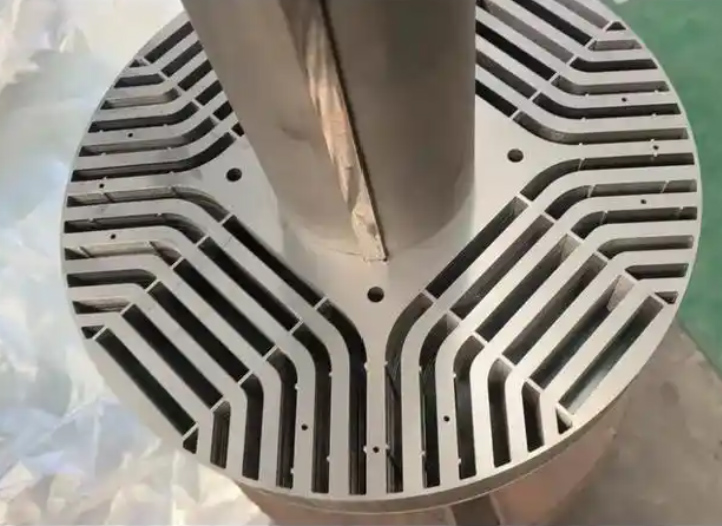
KSB SuPremE efficiency measurements (1500 rpm, 7.5 kW)
| Load | KSB SynRM | IE3 Induction Motor |
|---|---|---|
| 100% load | 92.7% | ~90% |
| 25% load | 90.4% | ~72% |
Most motors actually run below 60% load—SynRM's part-load advantage is its true killer feature.
Key conclusion: All major global drive manufacturers (ABB ACS850, Siemens Sinamics, Danfoss VLT, Schneider Altivar, etc.) have already built in native SynRM control modes. This technical barrier is rapidly disappearing.
If industrial giants value efficiency, the automotive and aerospace sectors value SynRM's reliability and rare-earth-free characteristics. In aerospace, both the U.S. F-35 and China's J-20 use synchronous reluctance motors as engine starter motors. In automotive, Tesla's Model 3 uses a synchronous reluctance motor as its drive motor. In October 2025, Hitachi's Astemo announced the development of a rare-earth-free BEV motor, combining ferrite permanent magnets with SynRM technology: 180 kW main drive, 315 kW total output, validating the feasibility of rare-earth-free SynRM in the most demanding automotive traction applications. In home appliances, China's Gree has applied synchronous reluctance motors to white goods, significantly reducing appliance energy consumption.
Why SynRM? Because it simultaneously satisfies three hard requirements:
No rare earths → avoids supply chain risk and price volatility
High-temperature reliability → ferrite at 250°C vs. NdFeB demagnetization risk at 130°C
High efficiency across the range → efficient at both rated point and part load
Global energy efficiency regulations are the biggest catalyst for the SynRM explosion:
| Region | Regulation | Requirement |
|---|---|---|
| EU | EU 2019/1781 | Mandatory IE4 for 75–375 kW motors |
| China | GB 18613-2020 | Mandatory IE3, encourages IE4/IE5 |
| USA | New DOE rules | Covers more motor types |
| India | IS 12615 | Gradually raising minimum efficiency |
| Japan | Top Runner | Requires highest available efficiency |
Market forecast:
| Metric | Data |
|---|---|
| Global high-efficiency motor market (2025) | ~US$12 billion |
| Global high-efficiency motor market (2030) | US$20–25 billion |
| SynRM segment growth rate | CAGR 10–12% (fastest) |
| SynRM share of new industrial motors (2025) | ~5–7% |
| SynRM share of new industrial motors (2035) | 25–30% |
Four major drivers: tightening MEPS making IE2 essentially illegal in new projects, corporate net-zero commitments, falling VFD costs, and heightened vigilance over rare-earth supply chain risks after NdFeB prices surged 200–500% in 2021–2022.
In this global motor revolution, China's strength cannot be underestimated. Nanjing Ruipeng Technology and its R&D platform Nanjing Reneng Tengshi Power have strategically positioned themselves in the synchronous reluctance motor field since 2018. Using a high-grade ferrite-assisted PMa-SynRM design, they achieve IE5 grade-1 energy efficiency, with efficiency up to 97.2%, power factor 0.87–0.95, power range 1.5–400 kW, and IEC standard dimensions for direct replacement of induction motors. Renengli vs. international benchmark (KSB SuPremE):
| Comparison item | KSB SuPremE | Renengli PMa-SynRM |
|---|---|---|
| Technology route | Pure SynRM | Ferrite PMa-SynRM |
| Power range | 0.55–450 kW | 1.5–400 kW |
| Maximum efficiency | 96.6% | 97.2% |
| IE rating | IE5 (limited range) | IE5 (full range) |
| Power factor | ~0.75–0.85 | 0.87–0.95 |
Ruipeng Technology has completed compatibility testing with drives from ABB, Yaskawa, Danfoss, Nidec, Delta, Inovance, Veichi, INVT, STEP, Eurotherm, and many other brands, and has achieved large-scale applications at companies including Chalco, Shengli Oilfield, and Vanadium & Titanium Steel.
From ABB's sales overtaking induction motors in Europe, to Tesla Model 3's drive choice, from F-35/J-20 engine starting, to Hitachi Astemo's rare-earth-free BEV motor—global giants have already voted with their actions. As global regulation tightens, rare-earth prices fluctuate, and dual-carbon goals force change, synchronous reluctance motors are moving from a "niche technology" to a "mainstream choice." And the PMa-SynRM that stands at the forefront with the optimal balance of efficiency, cost, sustainability, and reliability will be a green calling card for Chinese companies on the global stage.
Source Above text and images are from the WeChat public account: Renengli (瑞能力)