

As we all know, the inverter is an essential technology for electrical professionals. Controlling motors with inverters is a common method in electrical control, and proficiency in this technology is often required. With limited knowledge, I have summarized relevant knowledge points today, aiming to share the wonderful relationship between inverters and motors.
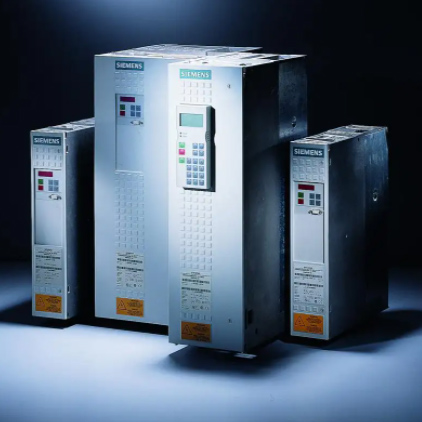
Let's briefly understand these two devices first.
A motor is an inductive load that resists changes in current, generating a large current change during startup.
An inverter is an electrical control device that converts power frequency power into another frequency using the on-off action of power semiconductor devices. It mainly consists of two circuits: the main circuit (rectifier module, electrolytic capacitor, inverter module) and the control circuit (switching power supply board, control circuit board).
To reduce the motor starting current, especially for high-power motors—the larger the power, the greater the starting current. Excessive starting current places a heavy burden on the power supply and distribution network. Inverters solve this problem by enabling smooth motor startup without excessive starting current.
Another function of inverters is motor speed regulation. Many applications require motor speed control to improve production efficiency, and speed regulation is the core advantage of inverters. Inverters control motor speed by changing the power supply frequency.
The five most common methods for inverters to control motors are as follows:
Low-voltage general-purpose inverters have an output voltage of 380~650V, output power of 0.75~400kW, and operating frequency of 0~400Hz. Their main circuits adopt AC-DC-AC topology, and control methods have evolved through four generations:
Features: Simple control circuit structure, low cost, good mechanical characteristic hardness, meeting smooth speed regulation requirements for general transmissions. Widely used in various industrial fields.
Disadvantages: At low frequencies, output torque decreases significantly due to stator resistance voltage drop; mechanical characteristics are not as rigid as DC motors; slow torque response, low motor torque utilization, and poor stability at low speeds due to stator resistance and inverter dead-time effects. This led to the development of vector control frequency control.
This method aims to approximate the ideal circular rotating magnetic field trajectory of the motor air gap, generating three-phase modulation waveforms at once and controlling via inscribed polygon approximation of a circle.
Improvements include frequency compensation (eliminating speed control errors), flux amplitude estimation feedback (eliminating low-speed stator resistance effects), and closed-loop voltage/current control (improving dynamic accuracy and stability). However, complex control circuits and lack of torque regulation limit fundamental system performance improvements.
Vector control converts stator currents Ia, Ib, Ic of asynchronous motors in a three-phase coordinate system into AC currents Ia1, Ib1 in a two-phase stationary coordinate system via 3-phase to 2-phase transformation. It then transforms them into DC currents Im1 (excitation current equivalent to DC motors) and It1 (armature current proportional to torque) via rotor field-oriented rotation transformation.
Essentially, it equates AC motors to DC motors for independent speed and magnetic field control. By controlling rotor flux and decomposing stator current into torque and magnetic field components, orthogonal/decoupled control is achieved via coordinate transformation. Despite its revolutionary significance, accurate rotor flux observation is difficult, system performance is sensitive to motor parameters, and complex vector transformations limit real-world performance.
Proposed by Professor DePenbrock at Ruhr-Universität Bochum, Germany in 1985, this technology overcomes major vector control limitations with innovative concepts, simple structure, and excellent static/dynamic performance.
Currently widely used in high-power AC traction for electric locomotives. DTC analyzes the mathematical model of AC motors directly in the stator coordinate system to control motor flux and torque, eliminating complex vector transformations and DC motor emulation, as well as simplified mathematical models for decoupling.
VVVF, vector control, and DTC are all AC-DC-AC inverters with common drawbacks: low input power factor, high harmonic current, large DC-link capacitors, and no regenerative energy feedback (unable to operate in four quadrants).
Matrix AC-AC inverters eliminate the intermediate DC link and bulky, expensive electrolytic capacitors, achieving unity power factor, sinusoidal input current, four-quadrant operation, and high power density. Though not fully mature, it is a major research focus.
Key features: stator flux observation for sensorless control; automatic motor parameter identification (ID); real-time calculation of actual torque, flux, and speed; Band-Band control for PWM signal generation.
Performance: Ultra-fast torque response (<2ms), high speed accuracy (±2% without PG feedback), high torque accuracy (<+3%), and 150%~200% rated torque at low/zero speed.
Inverter-motor wiring is simple, similar to contactor wiring: three main power input lines, and output lines to the motor. However, parameter settings and control methods vary.
Most inverters share similar terminal layouts despite different brands: digital input terminals for forward/reverse/start-stop control; feedback terminals for operating frequency, speed, and fault status; speed reference terminals (potentiometer or keypad control).
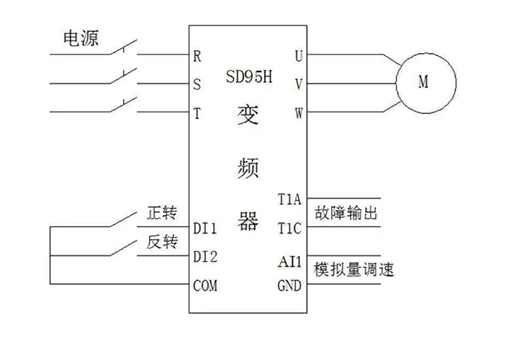
In addition to physical wiring, modern inverters support communication control: start/stop, forward/reverse, speed adjustment, and status feedback via communication cables.
Starting torque and maximum torque under inverter drive are lower than direct power frequency drive.
Power frequency startup causes severe shock, while inverters apply voltage and frequency gradually, reducing starting current and shock.
Typically, motor torque decreases as frequency (speed) drops. Flux vector control inverters compensate for low-speed torque deficits.
When inverter speed exceeds 50Hz, motor output torque decreases:
Standard motors are designed for 50Hz/rated voltage, with rated torque at this frequency. Speed regulation below rated frequency is constant torque speed regulation (T=Te, P≤Pe).
Above 50Hz, torque decreases linearly inversely proportional to frequency. For example, torque at 100Hz is ~50% of torque at 50Hz. Speed regulation above rated frequency is constant power speed regulation (P=Ue*Ie).
A motor’s rated voltage and current are fixed. For a 15kW/380V/30A inverter-motor system, operation above 50Hz is possible.
At 50Hz: output voltage=380V, current=30A. At 60Hz: voltage/current remain 380V/30A (constant power), so torque decreases (P=ωT, ω=angular velocity, T=torque).
Voltage formula: U=E+I*R (E=induced EMF). U/I constant → E constant. E=k*f*Φ (Φ=flux), so f increase (50→60Hz) reduces Φ. Torque T=K*I*Φ, so torque drops with flux.
Below 50Hz: I*R is negligible, U/f=E/f constant → constant flux → constant torque (constant rated current = constant maximum torque).
Conclusion: Motor output torque decreases as inverter output frequency increases above 50Hz.
Heating and cooling capacity determine inverter output current and torque capability
Carrier frequency: rated current is specified at max carrier frequency/temperature; lower carrier frequency reduces component heating without affecting motor current
Ambient temperature: inverter protection current does not increase at low temperatures
Altitude: reduces heat dissipation and insulation performance; derate 5% per 1000m above 1000m